
Featured · GCSC pilot vision
GCSC: A Safer Remodeling Journey Starts Before the First Deposit
Explore GCSC's planned platform: choose contractors, create AI-assisted requests, compare materials and plan financing, payments and protection.
17 min read · Planning guide
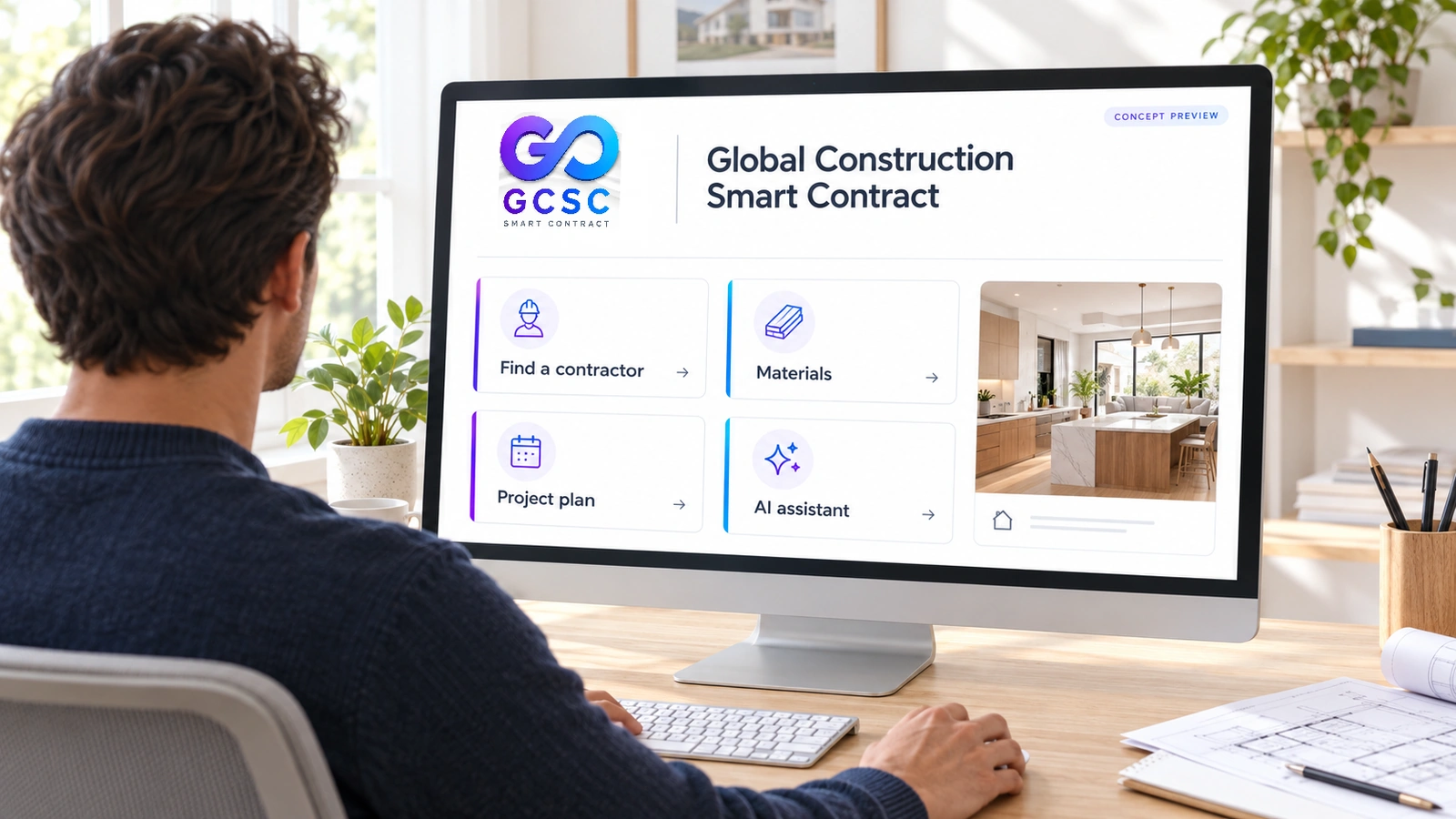
Imagine wanting to remodel your kitchen, finish your basement or add another room to your home. Instead of a clear starting point, you end up with dozens of open tabs: contractors here, windows there, financing somewhere else, reviews on another site, and the latest estimate lost among messages on your phone.
Global Construction Smart Contract, or GCSC, is being designed to bring that fragmented process into one project workspace. From your first photograph and contractor selection to materials, financing, staged payments and checking the result, the vision goes beyond a contractor directory or a protection service. It is a connected environment where homeowners and construction businesses can organize the entire project.
The pilot is planned to begin in Washington State. The central idea is straightforward: homeowners keep their choice, contractors receive a clearer brief, and decisions, documents and evidence of completed work stay connected.
This article describes the founder's product vision and planned capabilities, not a claim that every feature is available today. Financing, payments, optional protection and lead-refund arrangements still require final terms and implementation.
GCSC contractor selection starts with the homeowner
A useful platform should not push one company on you simply because it paid for promotion. GCSC envisions two routes: choose suitable contractors yourself and invite them to discuss your project, or publish a request so interested contractors can respond.
For example, a Bellevue homeowner planning a kitchen remodel could filter contractors by specialty, service area, availability, budget fit and verifiable experience with comparable projects, rather than call the first company in a search result.
A profile is intended to offer more than an attractive cover image. It should help the homeowner examine:
- Company history: how long the business has operated, which experience claims are supported and how much of its profile contains verifiable information.
- Comparable projects: what the company has completed and whether the examples resemble the proposed remodel.
- Customer reviews: which work each review concerns, when it was posted and whether the reviewer's project participation was verified.
- Documents and qualifications: information relevant to the work, with the status and currency of checks made clear.
- Working arrangements: availability, proposed timing, project-management approach and answers to the homeowner's questions.
The homeowner could select several companies and send each the same clear request, including photographs, scope and preferred timing. Comparing proposals for the same brief is more useful than trying to compare three estimates for three different scopes.
Business registration should not be presented as proof of craftsmanship. Washington L&I distinguishes general contractor registration from a competency test, and separate requirements apply to certain trades (Washington L&I consumer guidance).
Turn photographs into a clearer project request with AI
Homeowners should not have to know construction terminology to get started. Someone may know they want a warm, dry, comfortable basement without knowing how to describe substrate preparation, ventilation, waterproofing or the eventual finishes.
Under the GCSC concept, they could begin with photographs and a plain-language explanation. An AI assistant would ask follow-up questions and prepare a structured draft request, also called a job lead.
After receiving basement photographs, for instance, the assistant could ask about the intended use, desired result, known problems, approximate budget and timing. Those answers would become a brief that the homeowner can send to selected contractors instead of a scattered message thread.
The request is intended to combine the work location, project type, photographs, preferences, constraints, questions for the contractor and a preliminary list of issues to verify on site. The homeowner would review and edit the draft before approving it for sending or publication.
AI must not turn an assumption into an established fact. Photographs cannot reliably reveal every hidden defect, establish structural safety or replace an on-site assessment. The assistant's role is to frame the task and identify missing information, not declare a final price or construction method without verification.
For homeowners, that means a clearer beginning. For contractors, it means a request with fewer guesses and more useful starting information.
One request, several proposals and direct communication
Consider a hypothetical Kirkland remodel. The homeowner sends a prepared request to three selected companies. One offers an earlier start, another has strong experience with comparable work, and a third proposes a more suitable materials package.
GCSC plans to let the homeowner compare those responses and communicate directly with contractors on the platform. Questions, photographs, scope clarifications, estimate versions and approvals should remain linked to the project.
This is a two-sided workflow. Contractors could study the request, ask questions, prepare a proposal and use AI tools to organize information and draft calculations where appropriate. The final proposal and professional responsibility for it remain with the contractor.
Buying access to a lead must not mean buying the customer. Homeowners should retain the ability to assess a company, reject an unsuitable proposal and choose someone else. A remodeling contract follows agreement between the parties, not automatically from a contractor's lead-access payment.
Relevant leads instead of a random stream of inquiries
A strong platform has to work for both sides. Contractors need more than contact details: they need projects that match their specialty, geography, team capacity and schedule.
The planned filters would let contractors choose the requests they want to see by city and service area, work category, budget, preferred start and project size. They could exclude unsuitable work rather than spend time on jobs outside their capabilities.
Depending on the chosen marketplace model, a contractor could respond to a posted project, purchase access to a suitable lead or receive a direct invitation from a homeowner. Several businesses could compete through their proposals, experience and terms, rather than only their advertising position.
For example, a company specializing in Eastside basements could focus on matching requests instead of receiving a mix of distant roofing inquiries and small jobs outside its practice. Flexible settings should help both sides find a genuine fit.
Filters and paid access do not replace mutual selection. Even a well-matched lead does not guarantee a signed contract.
Withdrawing a lead and making refund rules clear
Discussion may reveal that a contractor lacks the right team, cannot meet the schedule or simply is not a good fit. Before a construction contract is signed, the proposed system would allow the homeowner to withdraw the request, change the search approach or choose another contractor.
For a contractor who has already paid for lead access, the founder is considering a refund of most of the fee, with a defined amount retained for processing or access already provided. The amounts, timing and eligibility rules are not finalized.
Rules would need to consider why the request was withdrawn, whether it was genuine and what had already been provided. A mismatch should not become an arbitrary penalty or leave the contractor without an explanation for a deduction.
Withdrawing a lead is also different from ending an existing remodeling contract. After signing, the parties' obligations and dispute process depend on their agreement and applicable requirements, not a single button in the project workspace.
The aim is a flexible search process with rules both sides understand in advance. Until those rules are approved, neither a particular refund percentage nor an unconditional full refund should be promised.
Materials and manufacturers: a construction search hub
Choosing a contractor solves only part of the problem. Homeowners still need to understand windows, doors, flooring, kitchen cabinets, siding systems and many other products.
GCSC's vision includes an organized construction catalog. Think of it as a “Google for construction”: a useful place to begin product research, compare options and prepare decisions, rather than collect information from dozens of disconnected websites.
The plan is to organize information by product category and manufacturer. Listings could help users compare specifications, available options, intended applications, supplier information, reviews and video reviews where available.
Supply geography is another important part of the idea. If a desired window is manufactured outside Washington, in another state or country, the homeowner should be able to understand whom to order through, whether supply to their area is available and what to ask about delivery, timing and service.
The catalog should not imply that every manufacturer worldwide is already listed at launch. Coverage, current product information and supply terms would depend on the database's development and supplier participation. The direction, however, is clear: connect materials research with the actual remodeling project.
A selected door, for example, could be discussed in its project context: whether it fits, when it can arrive, who will install it and how changing the selection affects the estimate.
An AI guide through the decisions, not another information maze
For someone undertaking a major remodel for the first time, even the sequence can be confusing. Should they find a contractor or select materials first? When should permit questions be resolved? What belongs in an estimate? What must happen before the next payment?
GCSC's planned AI consultant would help guide that sequence. It could explain terms, ask clarifying questions, help prepare for contractor conversations and show which decisions are still open.
Homeowners could learn through their own project rather than try to become experts in every construction discipline before starting. Their selected contractors, requests, proposals, materials, documents, messages, stages and completion evidence are intended to sit in one workspace.
The assistant would not have authority to quietly accept a contract, change the budget or move money on the homeowner's behalf. It supports decisions; the necessary approvals remain with the homeowner, contractor and relevant professionals.
A well-organized service should not promise that the homeowner never needs to participate. It should reduce confusion and help them understand the work while keeping them in control.
Explore financing before work begins
An important GCSC goal is to help homeowners explore financing before construction starts. The concept covers remodeling, additions, reconstruction and a clearly defined remaining scope of unfinished work, rather than only reimbursement after costs have already been incurred.
The proposed process begins with a prepared project: scope, selected or prospective contractor, estimate, schedule, materials requirements and milestone plan. That information could help present the project to suitable financing partners.
The longer-term concept also considers the home's anticipated condition and value after renovation. If the owner plans an addition or wants to make an unfinished area usable, the objective is to show a lender more than today's photograph: a supported plan for the intended result.
An AI projection is not a formal appraisal, and a prepared plan is not automatic loan approval. Financing availability, amount, security, interest rate and other conditions would depend on the product, borrower and property assessment, and the authorized partner's decision.
If approved, financing might allow the homeowner to avoid paying the entire remodel upfront from savings. Borrowed funds are not free money: repayment obligations, possible interest, security and budget changes need to be considered before signing.
The honest promise is therefore not “risk-free remodeling.” It is better project preparation, an opportunity to explore financing early and a clearer connection between spending and the agreed work plan.
Stage payments: materials and completed work accounted for separately
Handing over the entire budget and hoping for a good result should not be the foundation of trust. GCSC's model envisions agreed milestones with clear evidence and payment conditions.
Materials and labor could be tracked separately. If a payment is allocated to particular materials, the intended process would connect it to an agreed list, supplier order, invoices and other evidence of its use.
A “materials” label and a receipt photograph alone cannot prevent misuse. How tightly spending can be restricted would depend on the payment mechanism, partners and final contractual rules.
For labor, the proposed principle is simple: a defined amount of completed, accepted work corresponds to a defined payment. A milestone might cover preparation, a finished section or another agreed portion of the project.
With a suitable operating model, that could allow frequent payments, including daily payments for work that has actually been confirmed. A reliable contractor could gain more predictable cash flow, while the homeowner would not have to prepay a large scope that still exists only as a promise.
Payments would follow required evidence and approvals, considering the contract, any dispute and financing-partner requirements. AI could help check completeness and make a recommendation, but one uploaded photograph should not automatically remove every safeguard and release money.
Retaining part of a payment until a milestone or correction is completed would also require clear advance rules. Homeowner protection should not become an unjustified refusal to pay for properly completed work.
Follow progress with a phone and AI support
Project oversight should not require the homeowner to stay on site constantly and manually collect every document. GCSC envisions photographs, video, contractor reports and other evidence that can be added from a phone.
The workspace should show the current planned stage, what the contractor reports as completed, the evidence supplied and questions still open. Comparing that information with the schedule could help reveal delays earlier.
AI could help compare a report with the agreed scope, identify missing evidence and flag inconsistencies. If a stage is marked complete but a required document or agreed photograph is missing, for example, the system should expose the gap rather than create an impression of complete oversight.
A phone and an algorithm cannot see everything. Concealed construction, installation methods and some defects require qualified on-site review; mandatory inspections cannot be replaced by AI assessment. L&I recommends checking progress and obtaining required inspections before the relevant work is covered (Washington L&I Hire Smart guidance).
The value is earlier questions and a clearer project history. That reduces uncertainty, but does not turn remote monitoring into an infallible guarantee.
Optional protection: independent assessment and correction of confirmed defects
A contractor's bond, insurance or warranty does not mean every dispute will automatically result in a quick, free repair. L&I distinguishes types of bonding and explains that it cannot force a contractor to complete work or refund money (Washington L&I contractor-problem guidance).
The GCSC founder therefore proposes an optional project-protection program that a homeowner could purchase separately. A preliminary price idea is about $100 per project, but the final price, eligibility, coverage and legal structure are not approved.
The idea goes beyond compensation. It is an organized path from a specific concern to an independent assessment and, where the claim qualifies, correction of the work.
The homeowner would identify the departure from the agreement or other supported concern and provide evidence. An independent workmanship assessment would then examine the quality of the completed work.
The model under consideration could involve two independent qualified specialists or contractors with relevant expertise visiting the site. Their task would be to inspect the work, compare it with the scope and applicable requirements, record their conclusions and determine whether a correction is needed.
This is not an ordinary free estimate intended to sell another remodel. It is a separate, paid professional assessment, and the assessors' payment should not depend on their finding a defect.
If a qualifying defect is confirmed, the founder's concept is for GCSC to organize and pay for an agreed correction by another suitable contractor. Funding might come from the protection program and, where the contract allows, lawfully retained payment owed to the original contractor. That does not give the platform a right to seize money based solely on a homeowner's allegation.
Repairs could be carried out by a different contractor or, if future rules allow, one of the assessors. The latter would require transparent conflict-of-interest disclosure, separate approval and verification of the result, so that finding a defect does not become a way to award oneself a job.
Before launch, the program would need defined limits, exclusions, eligible project types, funding, an appeal process and any necessary authorization or partners. It cannot currently be sold as an available $100 insurance policy with an unconditional promise to redo any remodel.
The intended result is nevertheless practical: a homeowner with a confirmed problem should have a defined route to professional consideration and resolution, rather than a dead end of unanswered calls.
A reputation people can examine, not buy
The shared foundation is a verifiable history. GCSC envisions reviews connected to real projects, with contractor performance assessed through more than an advertising description.
The proposed platform would not sell positive ratings or quietly erase justified criticism to improve a profile. It would still need rules for replies, factual corrections, privacy and disputed content.
The FTC recommends considering multiple sources when evaluating reviews; appearance alone does not establish authenticity (FTC advice on online reviews). Its rule also covers fake reviews and certain practices involving suppression or payment conditioned on a particular sentiment (FTC rule guidance).
GCSC's longer-term vision includes blockchain-supported records as a way to make changes more visible, not an already operational system that automatically proves construction quality (GCSC public project overview).
A blockchain does not establish whether a photograph is honest or waterproofing was installed correctly. Its possible role is the integrity of the history, while professional assessment, privacy and a clear correction process remain necessary.
How the pieces would work together
Imagine a Bellevue homeowner wanting to turn an unfinished basement into a home office. They upload photographs, explain the goal to an AI assistant and review a structured draft request.
Next, they select contractors by experience, service area and reviews, or publish a lead for suitable businesses. In one workspace, they receive responses, clarify proposals, explore materials and compare options.
If financing is needed, the prepared scope, estimate and schedule could support a partner's review before work begins. Once agreements are in place, the project is divided into stages: purchases have supporting records, progress is documented by phone, and payments are linked to accepted work.
If a quality concern arises, the original agreements, photographs and change history remain available. If the project participates in a future protection program, its terms would govern the concern, including independent assessment and any qualifying correction.
The combination is the point of GCSC. Not a standalone “find a contractor” button or a promise of miraculous insurance, but a connected environment where search, communication, materials, documents, financing and oversight support each other.
More clarity and control, not a promise of zero involvement
No platform can honestly promise a remodel with no risk, no homeowner decisions and no possibility of disagreement. A more useful goal is to reduce blind payments, repeated searches and disputes without records or a clear process.
That is the direction of Global Construction Smart Contract. The homeowner chooses the contractor, the contractor receives a clearer task, materials and proposals stay with the project, and payments, evidence and responsibility connect to agreed stages.
Washington is the intended starting point, with the model and individual capabilities tested progressively. Follow the official GCSC overview for project information; specific features will depend on published availability and terms.
If you are planning a remodel now, start with photographs, a clear description of the result you want and questions for the future contractor. GCSC's longer-term purpose is to make the journey from that beginning to a completed project more organized, transparent and manageable.
General planning information, not legal, insurance, lending, engineering or permit advice for a particular property. Confirm requirements and contract questions with the relevant qualified professionals.